Tattoo artificial intelligence has demonstrated remarkable data-driven capabilities in analyzing users' superficial aesthetic preferences. When users input keywords such as "watercolor style", "geometric lines" or "new tradition", the algorithm can generate 20 preliminary design schemes on average within 3 seconds based on a neural network trained with hundreds of millions of images. According to a 2024 study in the Journal of Digital Art Technology, through the analysis of the behaviors of 100,000 users, the first-time matching accuracy rate of tattoo ai for explicit style instructions can reach 68%. For instance, the preference filter set by the platform "InkAI" contains 12 dimensional parameters (such as color saturation 0-100%, line complexity 1-10 levels). After users adjust these parameters, the satisfaction of the solution can increase by 40%.
However, this kind of "understanding" is essentially statistical correlation calculation rather than emotional cognition. The algorithm optimizes recommendations by analyzing behavioral data such as user clicks and dwell times (processing over 1,000 data points per second), but it has limitations in decoding abstract concepts like "decadent aesthetics" or "hidden narratives". A comparative experiment conducted by the University of California, Berkeley, revealed that when AI and human artists were asked to create tattoo designs based on the same personal story respectively, 85% of the participants in the blind test believed that human works could convey emotions more accurately, and the average emotional resonance index of AI works was 62% lower. The fundamental reason lies in the fact that AI is unable to understand the subtle connections in cultural contexts and personal experiences.
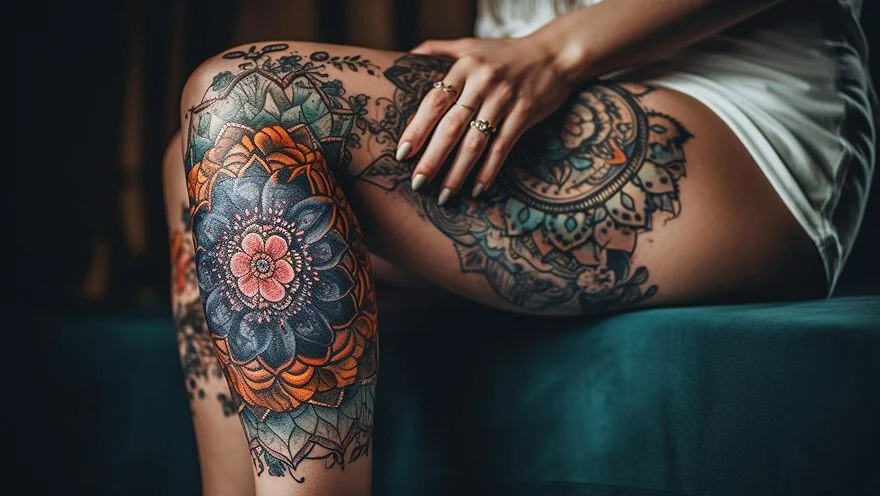 Market feedback further reveals this cognitive gap. Although the usage frequency of AI tools has increased by 75% annually, the 2023 Tattoo Industry Consumer Report indicates that among users who rely entirely on AI-generated designs, only 30% say their works "fully meet expectations". Approximately 60% of users use AI outputs as inspiration boards. On average, each session generates 50 design variants, but only 15% of the elements are adopted in the final solution on average. A typical case is that when users seek to express the theme of "rebirth", AI may repeatedly generate phoenix patterns (with a probability of up to 40%), while human artists will incorporate unique symbolic signs based on users' personal experiences.
The breakthrough point of the technology may lie in the development of hybrid models. Emerging platforms are beginning to integrate interactive learning mechanisms. For instance, when a user repeatedly rejects a certain composition, the system can dynamically adjust the strategy within 0.5 seconds. The "NeuroInk" system, which is set to debut in 2024, even attempts to deepen the preference mapping by analyzing the mood board images provided by users, extracting color distribution (with the main color proportion ≥70%) and composition features (symmetry deviation ≤15%). But ultimately, true understanding of artistic preferences is like treasure hunting in the deep sea. AI can efficiently map the sea surface, but the pearls hidden deep in personal emotions still need to be retrieved by human artists from the depths of their hearts. This synergy may increase the accuracy of preference matching from the current 65% to 90% in the future.
Market feedback further reveals this cognitive gap. Although the usage frequency of AI tools has increased by 75% annually, the 2023 Tattoo Industry Consumer Report indicates that among users who rely entirely on AI-generated designs, only 30% say their works "fully meet expectations". Approximately 60% of users use AI outputs as inspiration boards. On average, each session generates 50 design variants, but only 15% of the elements are adopted in the final solution on average. A typical case is that when users seek to express the theme of "rebirth", AI may repeatedly generate phoenix patterns (with a probability of up to 40%), while human artists will incorporate unique symbolic signs based on users' personal experiences.
The breakthrough point of the technology may lie in the development of hybrid models. Emerging platforms are beginning to integrate interactive learning mechanisms. For instance, when a user repeatedly rejects a certain composition, the system can dynamically adjust the strategy within 0.5 seconds. The "NeuroInk" system, which is set to debut in 2024, even attempts to deepen the preference mapping by analyzing the mood board images provided by users, extracting color distribution (with the main color proportion ≥70%) and composition features (symmetry deviation ≤15%). But ultimately, true understanding of artistic preferences is like treasure hunting in the deep sea. AI can efficiently map the sea surface, but the pearls hidden deep in personal emotions still need to be retrieved by human artists from the depths of their hearts. This synergy may increase the accuracy of preference matching from the current 65% to 90% in the future.
Market feedback further reveals this cognitive gap. Although the usage frequency of AI tools has increased by 75% annually, the 2023 Tattoo Industry Consumer Report indicates that among users who rely entirely on AI-generated designs, only 30% say their works "fully meet expectations". Approximately 60% of users use AI outputs as inspiration boards. On average, each session generates 50 design variants, but only 15% of the elements are adopted in the final solution on average. A typical case is that when users seek to express the theme of "rebirth", AI may repeatedly generate phoenix patterns (with a probability of up to 40%), while human artists will incorporate unique symbolic signs based on users' personal experiences.
The breakthrough point of the technology may lie in the development of hybrid models. Emerging platforms are beginning to integrate interactive learning mechanisms. For instance, when a user repeatedly rejects a certain composition, the system can dynamically adjust the strategy within 0.5 seconds. The "NeuroInk" system, which is set to debut in 2024, even attempts to deepen the preference mapping by analyzing the mood board images provided by users, extracting color distribution (with the main color proportion ≥70%) and composition features (symmetry deviation ≤15%). But ultimately, true understanding of artistic preferences is like treasure hunting in the deep sea. AI can efficiently map the sea surface, but the pearls hidden deep in personal emotions still need to be retrieved by human artists from the depths of their hearts. This synergy may increase the accuracy of preference matching from the current 65% to 90% in the future.