Allergen labelling is a documentation problem before it is a printing problem. What appears on the label has to match the formula that was actually produced, the thresholds the market applies, and the batch that is in the box, three things that drift apart if nobody checks them. An e-commerce brand that puts the QC checkpoints at the factory, rather than at the printer, avoids last-minute label reorders and marketplace compliance questions. The checkpoints are cheap; the reprints are not.
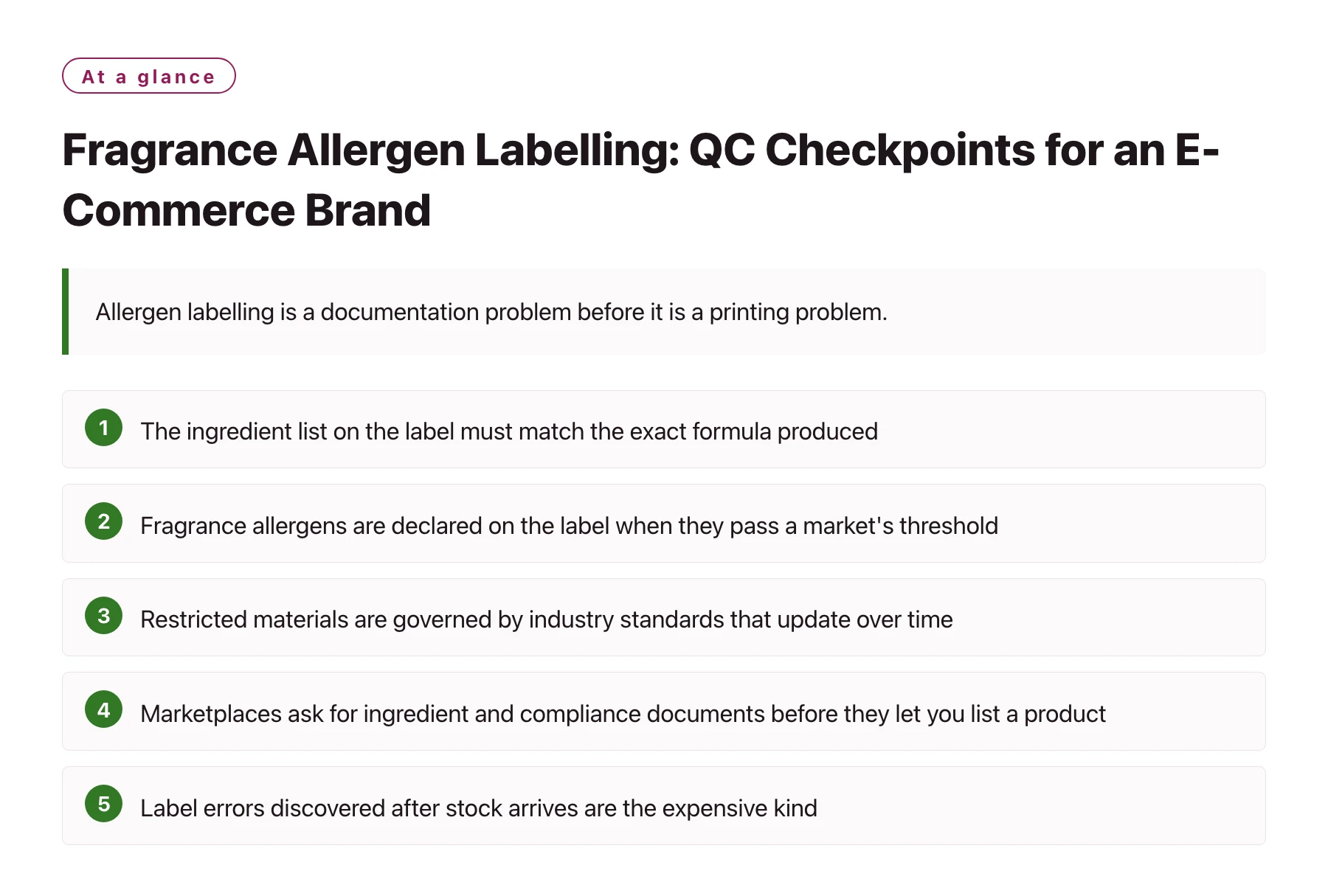
Key takeawaysThe ingredient list on the label must match the exact formula produced, which makes the batch record, not the approved artwork, the reference for label truth. · Fragrance allergens are declared on the label when they pass a market's threshold, and the calculation starts from the concentration data the concentrate supplier provides. · Restricted materials are governed by industry standards that update over time, so the formula documentation should carry a review date [2]. · Marketplaces ask for ingredient and compliance documents before they let you list a product, so the file the brand keeps for regulators is the same file the storefronts want. · Label errors discovered after stock arrives are the expensive kind, because a small e-commerce brand pays for the reprint, the relabel or the repack itself.
Running a small e-commerce brand means the label is often the only document customers and marketplaces actually read. A scent that performs well can still fail at the label stage if the ingredient list is incomplete, misnamed or out of sync with the formula.
This is a checklist for putting the QC checkpoints in the right place, at the factory, between formula freeze and label printing, so that the allergen declaration is true by construction rather than by luck.
What the label actually rests on
A fragrance label declares ingredients in a standard nomenclature, and the reference names are maintained in official ingredient databases [1]. The first QC checkpoint is not creative; it is that every material in the produced formula appears under the accepted name, spelled the way the registry spells it.
The second checkpoint is quantity, not just name. Allergen declarations are threshold-based in several major markets: below a certain level in the finished product, the ingredient still appears in the ingredient list, but the specific allergen call-out is not required. That calculation depends on the dosage, how much concentrate sits in the finished product, which is a number the factory owns.
The QC checkpoints, end to end
| Checkpoint | What is verified | Where the evidence lives |
|---|---|---|
| Formula-to-INCI mapping | Every material has the accepted ingredient name | Formula file and ingredient database reference |
| Allergen list and dosage | Threshold calculation uses the produced dosage | Concentrate specification from the factory |
| Restricted-material review | Current usage limits applied and dated | Documented review of the formula [2] |
| Label artwork approval | Artwork matches the frozen ingredient list | Signed artwork reference |
| Batch confirmation | The batch in the box matches the approved formula | Batch record and release check |
The chain runs from formula to box. The brand approves the last link, but every earlier link has to be verified where the data is produced, and that is normally the factory, not the print shop.
Market rules shape the same file
Different markets express the same underlying requirement differently. In the EU the labelling rules are tied to the cosmetic product file and the responsible person; in Canada the label has to carry the ingredient information in the required layout [3]. The details differ, but the file underneath, formula, ingredient list, dosage, testing, is the same file, which is why it is worth building once and reusing.
If your products come from white label fragrance manufacturing, the ingredient master and the factory's batch discipline are the only things standing between the label and the truth. Agree on a single ingredient master that is updated when the formula changes, and let every label and every marketplace submission read from that master; as long as the master is true, the label is true.
Batch control is the last checkpoint
A label describes a formula; the box contains a batch. The final checkpoint is confirming that the batch record for what is actually being shipped matches the approved formula and the frozen ingredient list. For a small brand buying finished product, the batch record is the document that makes the label true.
This is where the supplier's own discipline shows. A manufacturer that batches consistently answers the question in minutes rather than days, and the check is faster still when the supplier publishes its standards openly, as www.xuelei.com does on its own site, because there is a concrete list to verify against instead of a verbal promise.
Print the labels only after the batch record exists. When the artwork is approved before the batch is produced, a formula change in between produces a label that describes a product that never shipped, the classic e-commerce reprint scenario.
Sources
- EU CosIng — Cosmetic Ingredient Database (European Commission) —— The European Commission's CosIng database of cosmetic ingredients, listing ingredient functions, restrictions and labelling requirements under EU cosmetics law.
- IFRA Standards Library (International Fragrance Association) —— The IFRA Standards Library lists the restrictions the fragrance industry applies to individual fragrance ingredients, based on safety assessments; it is the reference point for compliant fragrance formulation.
- Health Canada: Cosmetic Safety —— Health Canada's cosmetics pages, covering cosmetic notification, the ingredient hotlist and safety requirements for cosmetics sold in Canada.
Frequently asked questions
Who is responsible for fragrance allergen labelling, the brand or the factory?
Legally the brand is responsible for what goes on sale; practically, the data comes from the factory. The brand should verify that the ingredient master, the dosage and the batch record all line up before approving artwork.
Do allergen thresholds differ by market?
Yes. The same fragrance can be labelled differently depending on where it is sold, which is why the dosage calculation and the ingredient master should be built once and checked per market before any label is finalised.
What is the difference between the ingredient list and the allergen call-out?
The ingredient list names everything in the product; the allergen call-out highlights named fragrance allergens above a market's threshold. Both read from the same formula data, but only the threshold-based parts change by market.
How do I check that a factory's compliance documents are current?
Ask for the review dates: when the formula was last checked against the current restrictions and when the ingredient master was last updated. A dated review is verifiable; an undated promise is not.
What happens if a marketplace questions my ingredient list?
You should be able to answer from the file: the INCI mapping, the dosage calculation and the batch record for the batch in question. If those three documents line up, most marketplace questions resolve within a day or two.